If you sell an electronics accessories brand or a DTC brand selling a technical product on TikTok Shop in the United States, the category decides almost everything about how your creator programme should be built. Nobody buys a 60-dollar charger because a creator said it changed their life. They buy it because the video showed the cable surviving a bend test, the port fitting a case, and the charge rate on a real phone. Electronics content is judged against a spec sheet the viewer already has in her head, and the only creators who can meet that test are the ones whose audience already argues about specs. This guide covers the four decisions that separate a campaign that moves inventory from one that produces nice footage: why niche reviewers beat lifestyle creators, five formats that answer a buyer's real questions, how to plan around launch windows and a long decision cycle, and how to turn one review into a year of assets.
Each section below is written to be handed to a creator or used in your next brief.

Why electronics content has to show the spec, not describe it
A three-dollar decision is made in three seconds; a sixty-dollar electronics decision takes days or weeks, and it is made by elimination. The buyer watches six videos, rules out four products, and buys the one whose failure modes were explained honestly. That is why the content that converts in this category is rarely the most enthusiastic — it is the most specific. A creator who says 'the hinge is the weak point, but it held for four months' sells more than one who says 'the build quality is incredible', because the first sentence is a claim the viewer can check.
Turn warranty and support into content, because it is the least contested ground in electronics. A two-minute video showing how to claim warranty, what the box must contain, and how long a replacement takes answers a question every buyer has and almost no brand films. It also reduces support tickets, which makes it the only creator content that pays back twice.
Step 1 — Pick niche reviewers over broad lifestyle creators
Choose creators by whether their audience argues about specs. The signals are simple: comments containing model numbers, comparisons to a previous generation, or complaints about a measurement. Follower count matters far less than whether the creator owns a caliper, a power meter, or a decibel app. A 20,000-follower reviewer whose audience is shopping for one specific category will outperform a 400,000-follower lifestyle creator every time on conversion, and cost a fraction as much. Build the roster by product category, not by audience size.
Name the alternatives carefully. Comparison content is the highest-converting format in electronics, and also the one that creates legal and relationship risk when the brief is casual. Set the rules in writing: compare against the previous generation or a category standard rather than a named competitor, avoid claims about another brand's failure rates, and never show a competitor logo in a thumbnail. A creator who can say this one runs cooler than the model it replaces gets the same persuasive effect without the letter from a lawyer.
Step 2 — Five formats that answer a buyer's real questions
Five formats cover almost every question. Unboxing and first-impressions, filmed in one take, establishes what is actually in the box — the most common source of one-star reviews. Setup, showing the first ten minutes of real use, answers 'is this annoying to live with'. Stress test, meaning one destructive or extreme demonstration, answers durability. Comparison against the two obvious alternatives answers 'why this one'. And daily carry, a week-later check-in, answers the question no launch video ever answers: does it still work, and do you still use it.
Put the two weakest points in the brief, not just the strengths. A reviewer who is allowed to say 'the app is clunky' will be believed when she says the battery is excellent, and the video will rank better because comments stay argumentative instead of defensive. Brands that hide the weakness get a polite video nobody trusts; brands that name it get a specific one that sells.

Step 3 — Plan around launch windows and a long decision cycle
Electronics has two calendars running at once. The launch calendar is short and fixed: the first 72 hours after a product goes live decide whether the algorithm keeps serving it, so reviews must be staged before the announcement, not commissioned after. The decision calendar is long: a buyer who sees a review in March may purchase in November, which means the same asset has to still be findable eight months later. Plan the launch wave around the announcement, then keep a always-on layer of comparison and daily-carry content running through the year so the product stays in the consideration set instead of disappearing after week two.
Put compliance and honesty in the same paragraph of the brief. Anything claimed on camera has to be either measured in the video or quoted from the published spec sheet — no improvised numbers, no up-to figures that were never tested. For US listings that means FCC identifiers, warranty terms and voltage compatibility stated correctly, because a single wrong claim is what turns a good review into a returns problem. A creator told to leave out anything they cannot measure produces content that survives scrutiny.
Step 4 — Turn one review into a year of assets
One good review should produce twelve months of assets, and the brief should say so. From a single eight-minute review: three short cuts for ads, one comparison clip against each major alternative, one setup or how-to clip for support pages, one still frame of the product in real use, and one 'six months later' follow-up that the same creator films on a second, cheaper booking. That follow-up is the highest-value asset in the whole programme, because almost no brand asks for it and it answers the only question left in a long decision cycle.
Electronics rewards repetition. A buyer who sees the same creator use the same product in three different videos across six months treats it as a real part of that person's setup rather than as an ad, and that familiarity is worth more than one high-production launch film. Sign a small number of creators to a six- or twelve-month framework with two deliverables per quarter, and reuse the footage on the product page and in paid social — the asset that convinces a TikTok viewer also reduces hesitation on the listing.
How DAMI runs long-cycle 3C creator programs
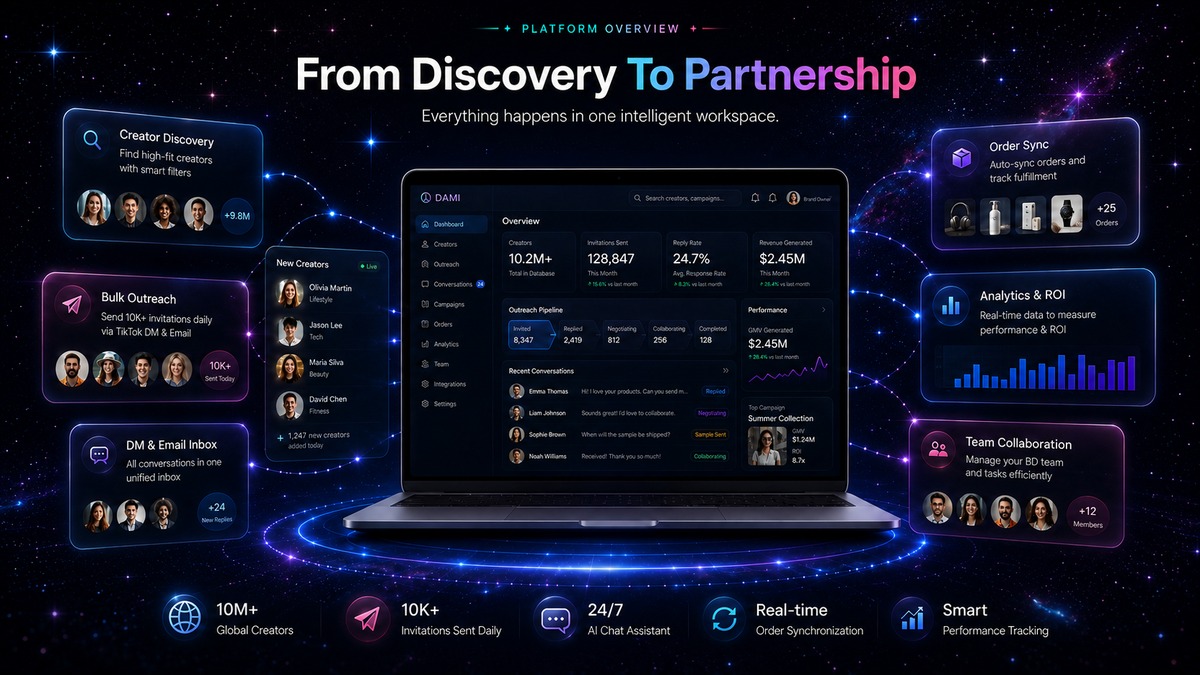
DAMI brings an 8-million-plus creator database, competitor and competitor-store creator search, automated outreach tasks, AI-assisted outreach, sample management, campaign management, store analytics, and multi-store team dashboards into one place. For a category programme that means an 8-million-plus creator database to source by niche, competitor and competitor-store creator search to see which creators already work with brands like yours, automated outreach tasks so follow-ups do not depend on memory, AI-assisted outreach to keep conversations moving, sample management to track what was sent and what came back, campaign management to hold every SKU and deadline together, plus store analytics and a multi-store team dashboard so everyone reads the same numbers.
A category roster, a launch calendar and a content library belong in one system, not five spreadsheets. Start with DAMI and run creator marketing as a process.

Frequently asked questions
Should we pay a big tech reviewer or ten small ones?
Ten small ones in the same niche, for the first launch. Electronics buying is elimination-based, and ten reviews let a buyer eliminate faster. Big reviewers are worth it once you have a product the niche already respects.
How do we handle a creator saying something negative?
Leave it in, and put the two weakest points in the brief so the criticism is predictable. A review with one honest complaint converts better than one with none, because the audience stops looking for what is being hidden.
When should reviews go live relative to launch?
Within 72 hours of the product going live, which means filming has to happen before the announcement. A review posted in week three competes with the brand's own content and with every creator who was faster.
Is a six-month follow-up worth paying for?
It is usually the cheapest high-value asset in the programme. It answers durability, which is the remaining question in a long decision cycle, and almost no competitor is publishing one in the United States.
Conclusion
Category marketing in the United States is not won by finding better creators. It is won by matching the creator, the format and the moment to the specific question a buyer already has. Do that and an ordinary roster starts producing content that sells.
Pick the format first, write it into the brief, put a date on every stage, then reuse what worked instead of commissioning more of what did not. DAMI brings an 8-million-plus creator database, competitor and competitor-store creator search, automated outreach tasks, AI-assisted outreach, sample management, campaign management, store analytics, and multi-store team dashboards into one place. Get started with DAMI and build the next campaign from records, not from instinct.