If you sell on TikTok Shop in the United States — whether you run a DTC brand with an in-house growth team that reuses creator content in paid ads — you already know that getting a creator to say yes is the easy half. In the United States, the most expensive sentence in creator marketing is 'we'll sort out usage later'. The video performs, the growth team wants to put spend behind it, and suddenly nobody can say whether the brand has the right to run it as a paid ad, for how long, in which markets, or whether the creator's face can appear in a version someone else edited. This guide covers the four parts that decide whether that yes turns into usable content: the deliverable list, the usage rights window and scope, the payment schedule tied to milestones, and the termination terms that protect both sides.
Everything below is written to be used in your next campaign, not filed away.
Why usage rights become the expensive part
Creator content is now the cheapest performing ad creative most DTC brands have, which means the rights around it carry real value. A video licensed for organic use only cannot legally be boosted. A 90-day paid license that quietly expired last month turns a working ad into a liability. And a license that never specified edits means every cut-down version is a small negotiation. The fix costs one paragraph at signing; the alternative costs a renegotiation at the worst possible moment.
Step 1 — List the deliverables precisely
Number the deliverables so nobody argues about scope later: one hero video, 30 to 45 seconds, vertical, with a hook in the first 3 seconds; three cut-down versions at 15, 10 and 6 seconds; nine still images exported from the footage; all raw files delivered within five business days of publication; and written confirmation of the post URL. Specify the file format and the delivery channel — a shared drive, not a chat attachment. 'Send us the content' is not a deliverable list, and it is the sentence that most often leads to a brand paying twice for the same asset.
Step 2 — Define the rights window and scope
Two numbers and three scopes. Numbers: organic use in perpetuity, and paid usage for a fixed term — 90 days and 6 months are the common bands, priced differently. Scopes: which platforms (TikTok only, or Meta and YouTube as well), which geographies, and whether the brand may edit, add subtitles, dub, or combine the footage with other material. Also state the exclusivity window, if any: a 30-day category exclusivity is normal; an open-ended one is not. Put the start date of the paid window at first use, not at signing, or you will pay for months you never used.
Step 3 — Tie payment to milestones, not to a feeling
Split payment across three points so neither side carries all the risk: 50 percent on signing to reserve the slot, 30 percent on delivery of the first cut, 20 percent on publication and link confirmation. For creators with a track record, net-30 after publication is also normal. What matters is that each payment has a named trigger that can be verified from the record — not 'after we're happy with it'. If final approval depends on internal review, state the review window, for example three business days, and treat silence after that window as approval.
Step 4 — Write termination terms both sides can live with
Four clauses cover almost every real dispute. If the creator does not publish within the agreed window and does not respond for seven days, the brand may terminate and recover the unpaid balance. If the brand cancels after the shoot but before publication, the creator keeps the signing payment. If the content breaches the brief on the forbidden claims, the creator fixes it once at no charge. And on termination, all delivered footage stays licensed to the brand under the terms already paid for — no clawback of materials already used in market. Clear termination terms are what make a first collaboration repeatable.
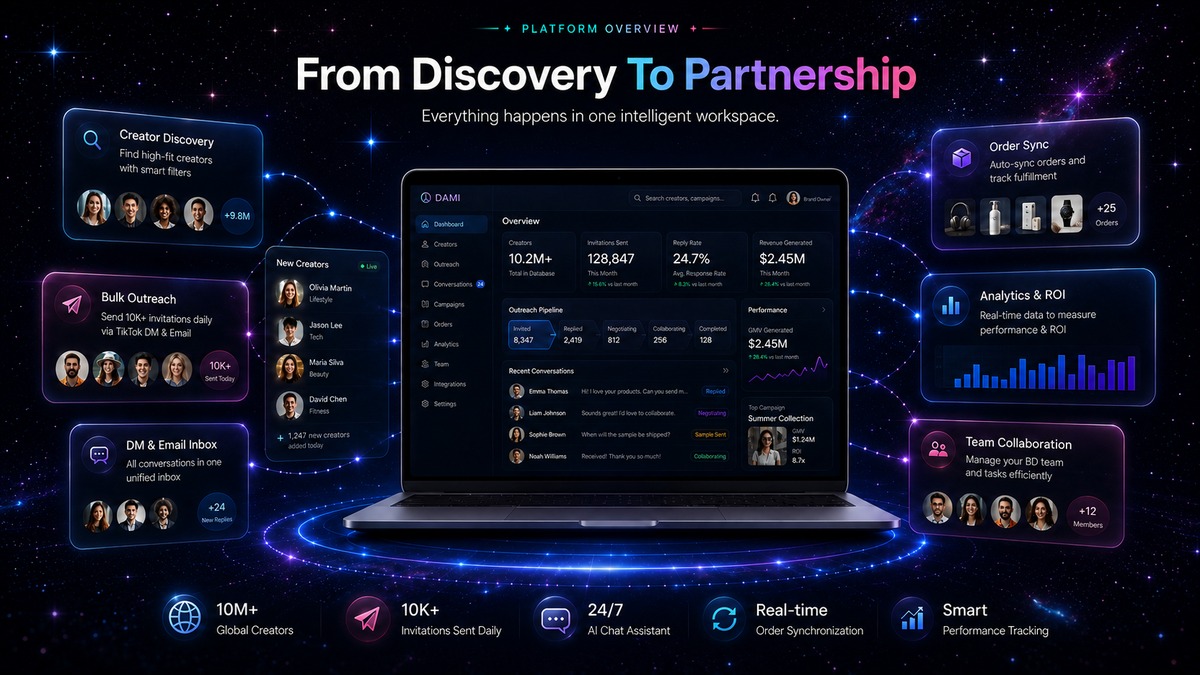
How DAMI keeps deliverables, rights and payments visible
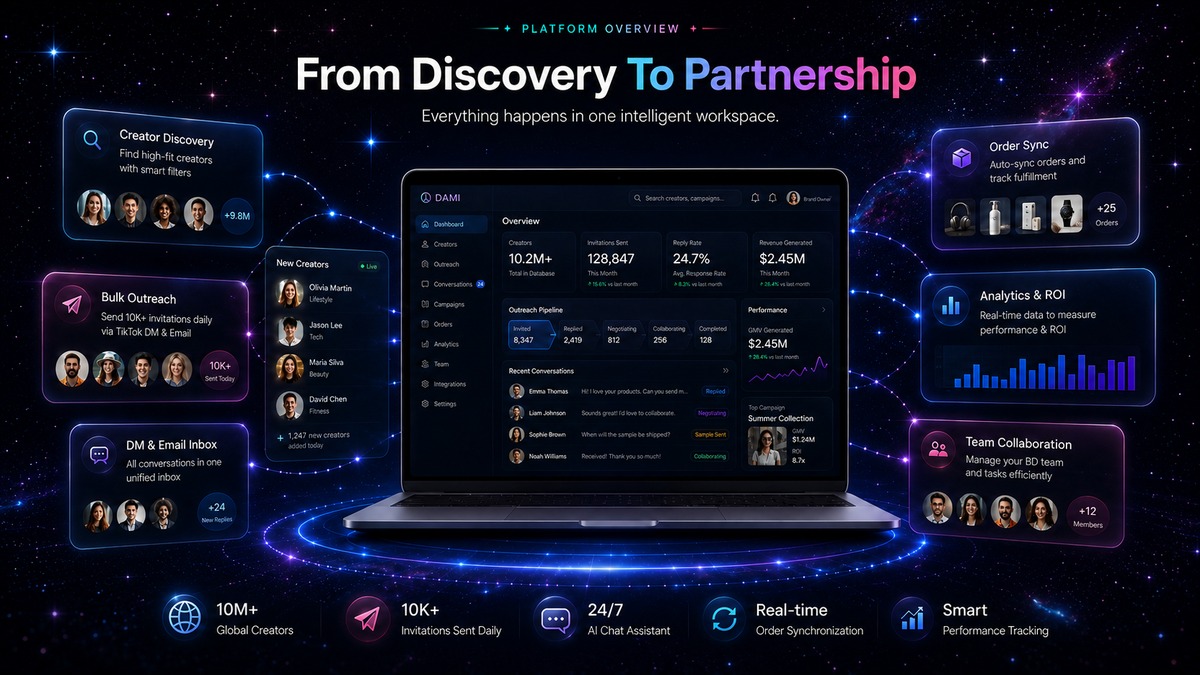
DAMI brings an 8-million-plus creator database, competitor and competitor-store creator search, automated outreach tasks, AI-assisted outreach, sample management, campaign management, store analytics, and multi-store team dashboards into one place. For collaboration execution that means an 8-million-plus creator database to source from, competitor and competitor-store search to see who already works with brands like yours, automated outreach tasks so routine follow-ups do not depend on memory, AI-assisted outreach to keep conversations moving, sample management to track what was sent and what came back, and campaign management with a multi-store team dashboard so everyone sees the same deadlines and the same numbers.
Briefs, samples, delivery dates and settlement all live in one record instead of five chat threads. Start with DAMI and run collaboration as a process.
Frequently asked questions
How much creative freedom should a creator get on the first collaboration?
Give freedom on execution and none on facts. Let them choose the hook, the pacing, and how they speak; hold the product points, the price, and the forbidden claims exactly as written. In the United States, the creators who deliver best are usually the ones who were told what must be true, not what to say.
What commission base prevents most arguments?
Net sales after cancellations, returns, and refunds — written into the brief with the exact definition. Gross sales looks generous and causes the argument, because the platform's gross number includes orders that never complete.
How many revision rounds is reasonable?
One structural round and one factual round. Beyond that, the cost is calendar time, not quality: each extra round adds about two days and the launch date does not move with it.
What should happen when a creator delays delivery?
Apply the delay plan you wrote before the campaign: 48 hours' notice moves the slot without penalty, later notice allows the brand to use the delivered draft and adjust the remaining fee. Decide it in advance so nobody has to negotiate under pressure.
Conclusion
Collaboration execution in the United States does not fail because creators are unreliable. It fails when the requirements, the dates and the money were never written down. Fix those three and the same creators suddenly look far more professional.
Write the brief, cap the revisions, put a date on every stage, and settle on the agreed cycle. DAMI brings an 8-million-plus creator database, competitor and competitor-store creator search, automated outreach tasks, AI-assisted outreach, sample management, campaign management, store analytics, and multi-store team dashboards into one place. Get started with DAMI and make the next collaboration start from records, not from memory.