If you sell on TikTok Shop in Vietnam — whether you run a home-goods or multi-category seller running several creator collaborations at once — you already know that getting a creator to say yes is the easy half. In Vietnam, most creator collaborations do not fail at the negotiation — they go quiet after the sample. The parcel arrives, nobody confirms it, the creator waits for a shooting date that was never set, and three weeks later the seller assumes the creator lost interest. The deal was never broken; it simply had no owner after the sample left the warehouse. This guide covers the four parts that decide whether that yes turns into usable content: how to close the outreach stage properly, how to run sampling and filming, how to manage publishing and acceptance, and how to settle and score the result for the next round.
Everything below is written to be used in your next campaign, not filed away.
Why collaborations stall in the middle, not at the start
A collaboration is a handover chain, and every handover is a place where information can drop. Outreach passes to logistics, logistics to the creator, the creator to the reviewer, the reviewer to finance. Four handovers, four chances to lose the thread. The teams that close campaigns reliably are not more persuasive; they simply attach a name and a date to each handover, so a stalled step becomes visible within a day instead of a month.
Step 1 — Close the outreach stage with four confirmed items
A creator is not 'confirmed' because they replied. Four items must be settled in writing: the quoted rate and what it includes, the content format and length, the publish window — not just a date but a two-day window, and the shipping address with a recipient name and phone. Only when all four are recorded does the record move from negotiating to confirmed. In Vietnam, the address step is where most delays originate, because the creator's receiving address is often an office or a family home and changes without notice.
Step 2 — Own the sample and the shoot date
Two dates decide whether the sample works: the delivery date and the filming date. Record the tracking number in the collaboration record the moment it ships, ask the creator to confirm receipt within 24 hours, and set the shoot date at the same time as the delivery confirmation — not after it. Send one reminder 24 hours before the shoot with the brief attached. Sellers who skip the reminder lose roughly one shoot in five to 'I thought it was next week', and a lost shoot usually costs a full campaign week.
Step 3 — Publish and accept on the same day
Publishing and acceptance should happen on the same day, in the same thread. Ask the creator to send the live link plus a screenshot of the post analytics at publish time. Within 24 hours, check five things: the link works, the product mentioned is the right SKU, the price and promotion are current, the subtitles are correct, and the account is public. Then archive the link in the record. A link that only lives in a chat cannot be reconciled at settlement, and it cannot be reused in ads later.
Step 4 — Settle, score, and reuse the result
Settlement closes the loop, and scoring opens the next one. Pay against the four confirmed items plus the published link, within the stated cycle. Then score the creator on three axes: delivery on time, revision count, and content performance against your own median. A three-line score turns next month's selection from a guess into a lookup. In Vietnam, the sellers who compound fastest are the ones who re-book the top two scorers before the next campaign brief is even written.
How DAMI tracks every collaboration from sample to settlement
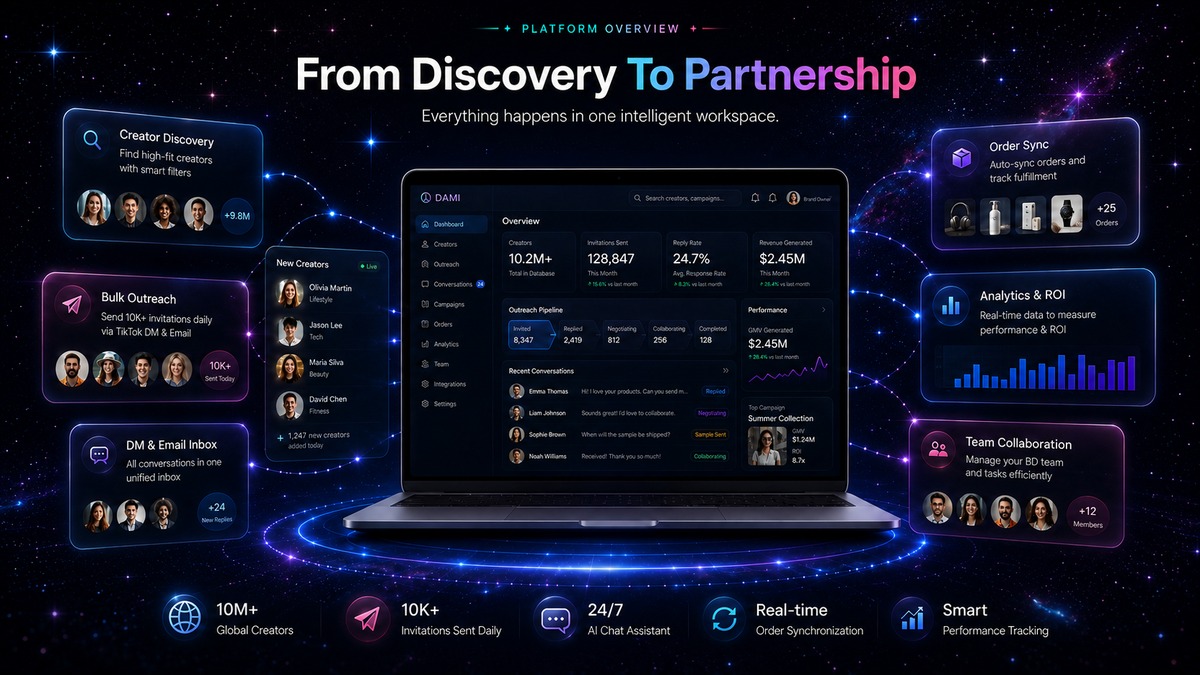
DAMI brings an 8-million-plus creator database, competitor and competitor-store creator search, automated outreach tasks, AI-assisted outreach, sample management, campaign management, store analytics, and multi-store team dashboards into one place. For collaboration execution that means an 8-million-plus creator database to source from, competitor and competitor-store search to see who already works with brands like yours, automated outreach tasks so routine follow-ups do not depend on memory, AI-assisted outreach to keep conversations moving, sample management to track what was sent and what came back, and campaign management with a multi-store team dashboard so everyone sees the same deadlines and the same numbers.
Briefs, samples, delivery dates and settlement all live in one record instead of five chat threads. Start with DAMI and run collaboration as a process.
Frequently asked questions
How much creative freedom should a creator get on the first collaboration?
Give freedom on execution and none on facts. Let them choose the hook, the pacing, and how they speak; hold the product points, the price, and the forbidden claims exactly as written. In Vietnam, the creators who deliver best are usually the ones who were told what must be true, not what to say.
What commission base prevents most arguments?
Net sales after cancellations, returns, and refunds — written into the brief with the exact definition. Gross sales looks generous and causes the argument, because the platform's gross number includes orders that never complete.
How many revision rounds is reasonable?
One structural round and one factual round. Beyond that, the cost is calendar time, not quality: each extra round adds about two days and the launch date does not move with it.
What should happen when a creator delays delivery?
Apply the delay plan you wrote before the campaign: 48 hours' notice moves the slot without penalty, later notice allows the brand to use the delivered draft and adjust the remaining fee. Decide it in advance so nobody has to negotiate under pressure.
Conclusion
Collaboration execution in Vietnam does not fail because creators are unreliable. It fails when the requirements, the dates and the money were never written down. Fix those three and the same creators suddenly look far more professional.
Write the brief, cap the revisions, put a date on every stage, and settle on the agreed cycle. DAMI brings an 8-million-plus creator database, competitor and competitor-store creator search, automated outreach tasks, AI-assisted outreach, sample management, campaign management, store analytics, and multi-store team dashboards into one place. Get started with DAMI and make the next collaboration start from records, not from memory.