If you are a small beauty or apparel seller with a sampling budget of a few hundred dollars a month and a team of two to five people, you have probably shipped free product to creators who never posted. The tracking page says delivered. The creator replies 'got it, thank you!' And then nothing. Two weeks later you are scrolling their profile, deciding whether to ask again — and whether asking again makes you look desperate. Every seller who ships samples has this story. Almost none of them have a process for it.
This guide covers the four moves that actually change the outcome: screening the profile before you ship, putting a date and a consequence in the message itself, tracking every sample in one list, and applying a stop-loss rule without emotion. Nothing here depends on a specific market — the same mechanics apply whether you sell from Jakarta, Manila, Bangkok, Ho Chi Minh City or Los Angeles.
Why samples go quiet after delivery
Sampling fails for boring reasons, not dramatic ones. A creator agrees in a friendly chat without ever committing to a date, so there is nothing to be late for. That same week three other brands shipped to them, and their calendar filled with paid work that has a contract behind it. The sample was not rejected; it was deprioritized. And because nobody tracks which samples are outstanding, the seller notices a month later, when the campaign window is already gone. The real cost is not one free product — it is the four weeks of assumed coverage that never existed.
Step 1 — Screen the profile before you ship
Screen before you ship, not after. Four signals settle most of it. First, posting cadence in the last 30 days: if the newest three videos are older than three weeks, this account is not currently producing. Second, whether they publish brand content at all — a feed of purely personal clips rarely accepts commercial briefs, no matter how big the audience. Third, the ratio of followers to average views: a 200k account averaging 3k views will deliver 3k views, not 200k, and the gap usually means bought followers or a stale audience. Fourth, competitive load: if they are mid-campaign for a similar product, your sample goes to the back of a queue you cannot see. Ten minutes of this check replaces a month of waiting.
Step 2 — Put a date and a consequence in the message
Give the sample a date before it leaves the warehouse. The message that works has four parts: what shipped, when it arrives, the two-day publish window, and what happens if that window is missed. For example: 'Shipping today, arriving Thursday. We would like the video live between the 12th and 14th. If those dates do not work, tell me before Friday and we will re-plan together; if I do not hear back by Friday, I will assume the slot is free and offer the sample to someone else.' That final sentence is the entire mechanism. A deadline without a stated consequence is a wish, and creators read it as one.
A worked example from a beauty seller shipping twelve samples a month. Before the change: no dates in the message, no tracker, a publish rate of twenty-five percent — three videos out of twelve parcels. After adding a two-day window and the 'if I do not hear back by Friday' line, eight of twelve published inside the same month, and two creators wrote back to renegotiate the date instead of disappearing. The budget did not change, the creators did not change, and the publish rate tripled. That is what a date in a message is worth.
Step 3 — Track every sample in one list
Track samples like inventory, not like favors. One record per sample, five fields: creator, product and SKU, ship date, expected publish date, actual publish date. Review the list every Monday and sort it into three buckets. On track: no action. Overdue by under seven days: one friendly nudge that quotes the original date back. Overdue by more than seven days: stop-loss. Sellers who start doing this usually find something uncomfortable — roughly a third of the creators they remember as 'ghosting' were never chased at all, because the information lived in one person's chat history and that person went on leave.
Six mistakes that account for most of the wasted samples we see. Shipping to an account whose last three posts are older than three weeks. Shipping without a date. Shipping ten parcels in one day and personalising none of them. Forgetting that shipping cost is part of the sample cost, so a forty-dollar free product is really a sixty-five-dollar free product. Chasing in a public comment thread, which converts a private ask into pressure. And treating silence as a permanent verdict, when the same creator often says yes three months later — if the last message was polite.
Step 4 — Apply a stop-loss rule without emotion
Decide the stop-loss rule while you are calm, then apply it without a debate. A workable version: at ten days past the agreed date, with no response after two nudges, close the collaboration, move the creator to a 'slow' list, and do not ship again for six months. Write the reason in the record so the next person on the team does not repeat the experiment. Keep the wording open: 'Closing this one out for planning purposes — reach out when your calendar opens up.' A creator who returns three months later with an apology and a video is a real outcome, and it only happens if the last message was not a fight.
Five columns reviewed every Monday is the entire system: creator, product and SKU, ship date, expected publish, actual publish. Add one field most trackers miss — what the creator said when confirming receipt. It is the cheapest predictor of who will post. A one-line 'got it, thanks' with no question usually precedes silence, while a creator who asks about the shade, the size or the angle is almost always going to film, because they are already thinking about the shot.
How DAMI keeps sampling from disappearing
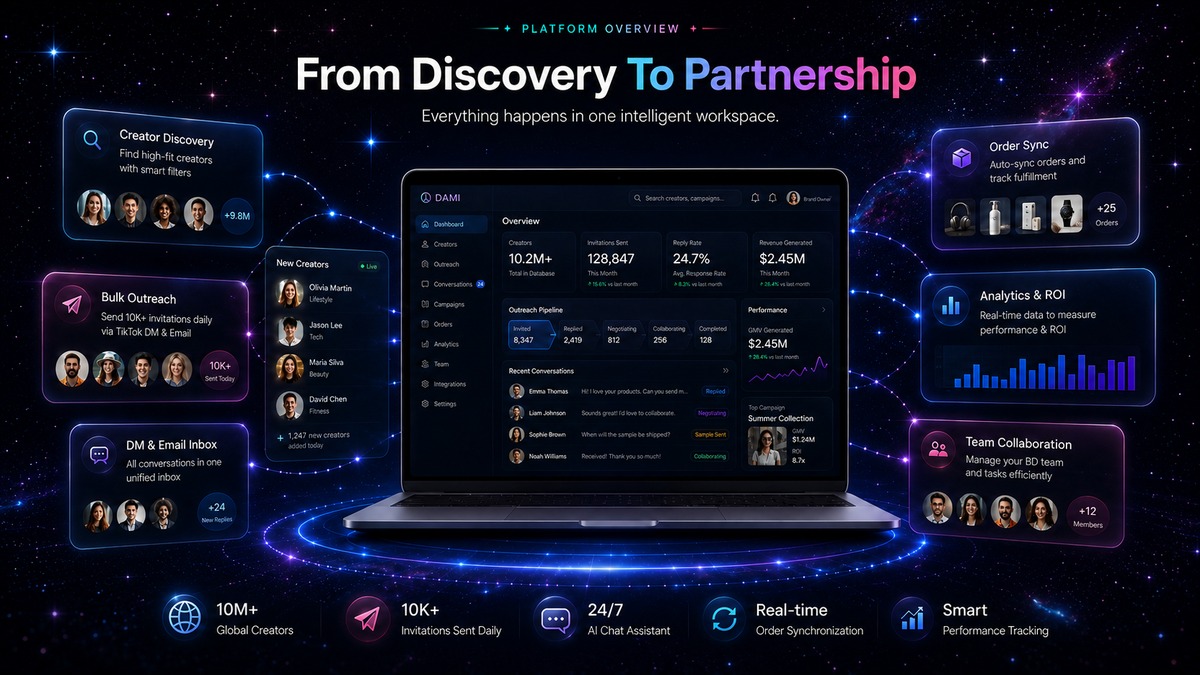
DAMI brings an 8-million-plus creator database, competitor and competitor-store creator search, automated outreach tasks, AI-assisted outreach, sample management, campaign management, store analytics, and multi-store team dashboards into one place. For a team of two to five people, the practical difference is that the list, the status and the numbers live in one place instead of being rebuilt every Monday from five different screens. For sampling specifically, that means three things working together: competitor creator search to see who is already producing for brands like yours before you spend a sample, sample management to record what was sent, to whom, and what came back, and automated outreach tasks so the follow-up on day three and day ten happens whether or not anyone remembers.
Start with DAMI and run this as a weekly routine instead of an emergency.
Frequently asked questions
How long should I wait before chasing a creator?
Three days after the expected publish date, quoting the original date back in the message. Waiting two weeks signals that the deadline was never real, and it also burns the part of the campaign window you could still have recovered.
Should I ask for the sample back?
Almost never worth it. Return shipping often costs more than the product, and the request turns a soft ending into a conflict. Write it off in the record, then use that data to change who you ship to next.
Ten small creators or three mid-size ones for a first test?
Ten small ones. You learn the packaging, the message and the follow-up routine at low cost. Move to mid-size creators once your publish rate is above seventy percent, because at that point a missed delivery is an exception rather than the norm.
Do paid collaborations have the same problem?
Far less often, and for a simple reason: money creates a date. The cheapest fix for free sampling is to attach a small fee or a commission bump to the publish deadline — it converts a favor into an obligation without changing the budget much.
Conclusion
Nobody stops shipping samples because creators are unreliable. They stop because they cannot see the pattern. Once every sample has a date, an owner and a status in one list, three unposted videos stop being a personal disappointment and become a number you can act on: publish rate. Raise that number and the same budget buys twice the content.
DAMI brings an 8-million-plus creator database, competitor and competitor-store creator search, automated outreach tasks, AI-assisted outreach, sample management, campaign management, store analytics, and multi-store team dashboards into one place. For a team of two to five people, the practical difference is that the list, the status and the numbers live in one place instead of being rebuilt every Monday from five different screens. Get started with DAMI and make the next round of decisions from records, not from memory.