If you are a growth-stage TikTok Shop seller doing between thirty and a hundred thousand dollars a month, already working with a dozen creators, and your videos keep crossing a hundred thousand views without moving the order count, this is the checklist you are missing. Two hundred thousand views, forty-nine orders, and a team meeting where everyone says the same thing: 'the traffic was good, the product just did not convert'. That sentence is almost always wrong. Traffic that does not convert is not good traffic — it is traffic from the wrong people, watching a video that never asked them to buy.
This guide covers the four moves that actually change the outcome: separating traffic quality from traffic volume, fixing the three seconds that carry the selling point, repairing the link-and-checkout path, and reading the result against your own median instead of against the view count. Nothing here depends on a specific market — the same mechanics apply whether you sell from Jakarta, Manila, Bangkok, Ho Chi Minh City or Los Angeles.

Why views and orders are not the same funnel
Views measure whether the content was watchable. Orders measure whether a specific person, at a specific moment, had enough reason and an easy enough path to buy. Those are two different systems, and a video can win the first while failing the second completely. When a seller says 'the traffic was good', they are usually describing a video that was entertaining to the wrong audience, with no product in the first three seconds, a link buried under a comment thread, and a price that changed between the video and the checkout page. Four failures, one number blamed.
Point 1 — Check whether the traffic is even the right traffic
Open the audience tab before you open the sales tab. Check four things: which countries the views came from — a video that travels to a market you cannot ship to is not traffic, it is entertainment; the age and gender split against your buyer profile; the average watch time, because three seconds of watch time on a thirty-second video means the hook worked and nothing else did; and the traffic source, since a video carried by the 'For You' page behaves very differently from one carried by a creator's own followers. If the country mix is wrong and the order rate is near zero, the video is not underperforming — it was aimed at the wrong room.
Point 2 — The first three seconds decide whether anyone can buy
Most creator videos lose the sale in the first three seconds, before the product exists on screen. The fix is mechanical: name the product in the first sentence, show the problem it solves in the next two, and put the price or the offer on screen before second eight. A useful test is to watch the video with the sound off — if you cannot tell what is being sold, neither could the viewer, and the viewer had less patience than you. The second half matters too, but differently: one clear reason to act now, said out loud, in the creator's own words rather than a scripted slogan.
A concrete example. Three creator videos, same product, same month: forty thousand views and twelve orders, sixty thousand views and nine orders, one hundred twenty thousand views and thirty-one orders. Sorted by views, the third wins. Sorted by conversion, the first wins by a factor of two — 0.030 percent against 0.015 percent — and the second is the one to cut. The seller had been ranking creators by reach for six months, which is why the middle video kept getting renewed. Once the table was sorted by conversion instead, the first creator received three times the budget and produced the quarter's best month, with fewer views than the account they replaced.

Point 3 — Repair the path from video to checkout
Audit the path with your own phone, in the app, as a buyer. Five checks. Is the product actually attached to the video, or does the viewer have to find it? Does the attached SKU match the product shown — the most common silent killer is a video advertising a new shade linked to the old listing. Does the price and promotion match what the creator said out loud? Does the landing page load in under three seconds on mobile data, not office wifi? And is there anything to catch the traffic afterwards: a live session, a pinned comment, a profile banner. Sellers fix the creative first because it is more fun. The boring path fixes convert more.
The mistakes repeat across almost every store we look at. Judging a video by its view count before checking the country mix. Rewriting the creative while the product attachment is still broken. Running a campaign with no live session and no pinned comment, so the traffic has nowhere to land. Comparing a beauty video against a home-goods median and concluding that beauty does not work. Ignoring the return rate until quarter end, when it has already eaten the margin. And crediting an order to the wrong SKU, which makes a good creator look bad and a bad listing look fine.
Point 4 — Judge the video against your own median
Stop comparing a creator video against a hundred thousand views and start comparing it against your own median. Take the last twenty creator videos, line up views, orders, conversion rate and revenue per thousand views, and find the middle of each column. Any video below the median on conversion is a content problem even if it beat the median on views; any video above it is worth studying and re-booking, even at modest reach. This is also how you find the quiet creators: accounts with thirty thousand views and twice the median order rate are usually the ones worth a long-term deal, and they are the ones a view-count dashboard hides.
Run the five checks in this order, because the cheap ones filter the expensive ones: attached SKU and price first, then landing page speed on mobile data, then whether the creator said the price out loud, then whether there is a live session or pinned comment catching the traffic, and only then the creative itself. Most 'the content did not convert' meetings end at check one or two, before anyone reopens the video.
How DAMI shows which creators actually convert
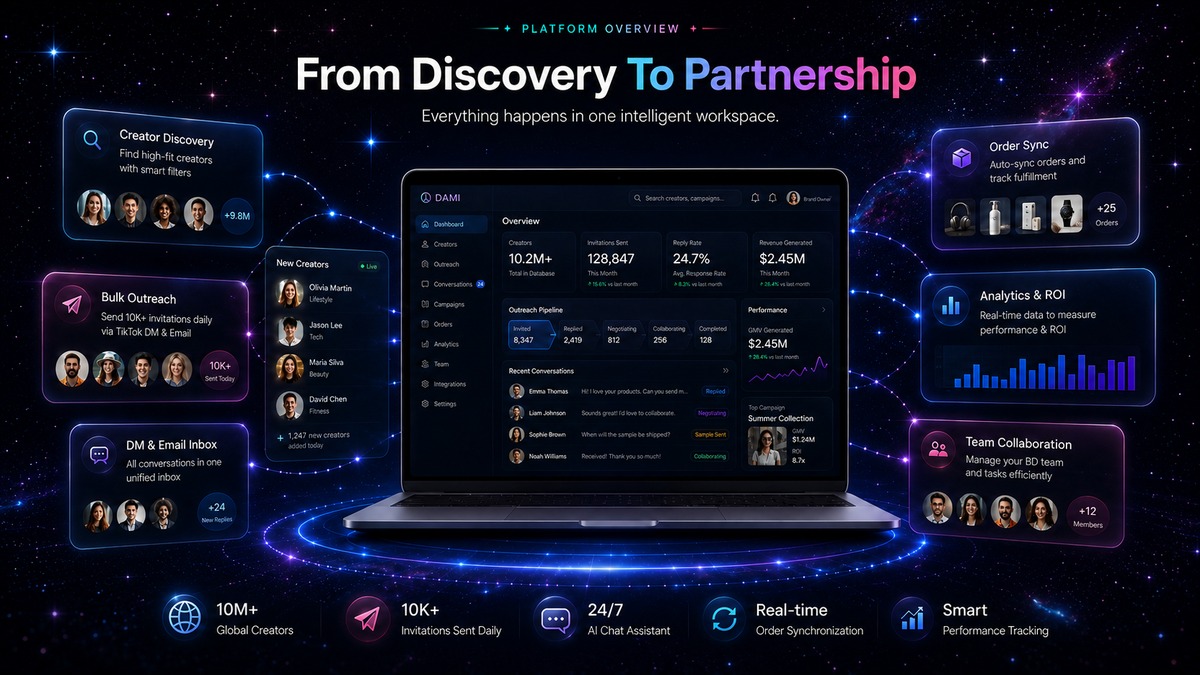
DAMI brings an 8-million-plus creator database, competitor and competitor-store creator search, automated outreach tasks, AI-assisted outreach, sample management, campaign management, store analytics, and multi-store team dashboards into one place. For a team of two to five people, the practical difference is that the list, the status and the numbers live in one place instead of being rebuilt every Monday from five different screens. The conversion view belongs next to the content view. Store analytics in DAMI tie creator content to orders and revenue, competitor-store creator search shows which creators are already selling comparable products rather than merely making watchable videos, and the team dashboard keeps views, orders and revenue per creator in one table so the weekly review is a lookup rather than a reconstruction.
Start with DAMI and run this as a weekly routine instead of an emergency.

Frequently asked questions
High views, zero orders — is the creator buying traffic?
Sometimes, but check the boring causes first: wrong country mix, product not attached, or a SKU mismatch between video and listing. Those three explain most zero-order videos, and a bought-audience account usually shows a follower-to-view ratio that is wrong in the other direction.
Should I lower the price to test conversion?
Test the path before you test the price. A price cut on a broken link path just teaches you that discounts do not work. Fix the attachment, the SKU and the landing speed, then run one price test with a single creator so the variable stays clean.
Can I use the creator video as a paid ad to rescue it?
Yes, and it is often the fastest fix for a video that converts but has stalled on reach — as long as you hold the usage rights before you spend. A video with poor conversion will not be saved by budget; you will simply pay more to send the same wrong audience to the same page.
How long before I call a video a failure?
Seven days, or until it stops accumulating views, whichever comes first. Use that window to check the path once, and do not re-edit a video that is already distributing — you cannot change a live post, only the next one.
Conclusion
Views answer a question nobody asked. The question that matters is which creator, saying what, sent which buyer to which listing — and that question has an answer, but only if views, orders and revenue sit in the same table. Fix the path first, then judge creators on conversion against your own median, and the next campaign will start from what worked instead of from what looked impressive.
DAMI brings an 8-million-plus creator database, competitor and competitor-store creator search, automated outreach tasks, AI-assisted outreach, sample management, campaign management, store analytics, and multi-store team dashboards into one place. For a team of two to five people, the practical difference is that the list, the status and the numbers live in one place instead of being rebuilt every Monday from five different screens. Get started with DAMI and make the next round of decisions from records, not from memory.