If you are a new seller or a one-to-three person team handling creator outreach yourself, sending thirty messages a week and getting three replies, the problem is almost never the creators — it is the message. A mid-size creator opens forty DMs a day. Thirty-nine of them start with 'Hi, we are a brand' and ask for a free video in exchange for product. Yours is the thirty-ninth. The problem is not that creators are rude or too big for you — it is that your message gave them nothing to reply to except 'no', and no reason to spend three minutes deciding.
This guide covers the four moves that actually change the outcome: rewriting the first message so it can be answered in one word, using three channels on a fixed cadence, separating batch outreach from precise follow-up, and coming back to a rejection with new information instead of the same ask. Nothing here depends on a specific market — the same mechanics apply whether you sell from Jakarta, Manila, Bangkok, Ho Chi Minh City or Los Angeles.

Why your message gets read and ignored
Outreach messages fail on arithmetic. A creator with forty daily DMs can give each one about four seconds of attention, and in those four seconds your message has to answer three questions: who is this, what do I get, and what exactly do you want me to do. Most messages answer the first badly ('we are a brand'), skip the second entirely, and bury the third under a paragraph about the company. Then they ask for a reply with no deadline and no fallback. Nothing is wrong with the creator's inbox — the message simply asked for more effort than it offered.
Step 1 — Write a first message that can be answered in one word
Four sentences, in this order. One: prove you watched something specific — 'Your review of the cream for oily skin last month is the reason I am writing, the part about the third-week texture change.' Two: state the offer as a number, not a feeling — 'flat fee of X, or X plus fifteen percent commission, plus the product'. Three: state the ask precisely — 'one 30-second video, filming in the week of the 20th, publishing by the 27th'. Four: end with a question that takes one word — 'Does that date work, or should I come back in November?' A message that can be answered with 'yes' or 'no' gets answered; a message that requires a negotiation gets postponed.
Step 2 — Use three channels on a fixed cadence
One channel is a single point of failure. Use three in a fixed order: the platform DM first, because that is where they live; email second, because it survives a crowded inbox and can carry a one-page brief; and the channel on their profile — Instagram or WhatsApp — only if the first two are silent. Cadence matters more than wording: day one DM, day three email, day seven final message on the profile channel, then stop. Three touches in a week, each slightly shorter than the last, and none of them a copy of the previous one. After the third, mark the creator as 'not now' instead of chasing a fourth time — that is what turns a professional list into a blocked account.
Here is the same message before and after. Before: 'Hi! We are a skincare brand and we love your content. We would like to collaborate — we can send you products, and in return please make a video for us. Let us know if you are interested!' Four sentences, two asks, no number, no date, no reason it was sent to this person. After: 'Your review of the serum for combination skin in August, especially the part about the third-week texture change, is why I am writing. We pay a flat eighty dollars plus the full set. One thirty-second video, filming in the week of the 20th, live by the 27th. Does that date work, or should I come back in November?' Same offer. Reply rate moved from roughly one in ten to one in three, and the change took eleven minutes.

Step 3 — Separate batch outreach from precise outreach
Batch and precise are different jobs and should never share a message. Batch outreach is a volume game: filter a list of two hundred creators by category, follower band and recent activity, send the same structure with three personalised fields — their video reference, the product, the number — and expect a ten to fifteen percent reply rate. Precise outreach is a conversion game: twenty hand-picked creators, a message that references their audience and a specific collaboration idea, a rate that is above their usual. Run batch on Monday, precise on Wednesday, and never mix the two lists, because a creator who receives a template after being hand-picked feels downgraded and will not reply twice.
The list of mistakes is short and expensive. Asking 'can we collaborate' with no offer attached. Sending a company deck instead of a number. Following up daily, which reads as pressure rather than interest. Copy-pasting the same paragraph to forty creators who all know each other, because in most categories the same fifty names talk to each other weekly. Treating email as spam and never using it. And burning the whole list in one week with no record of who said what, so the next person on the team starts from zero with the same names.
Step 4 — Come back to a rejection with new information
A 'no' is a timestamp, not a verdict. Record three things when it happens: the reason if one was given, the rate they quoted, and the month they said would be better. Then come back between two and six weeks later with something new — a different product, a higher commission instead of a fee, a bundle with another creator they know. Coming back with the same offer teaches them that your messages are automated; coming back with a changed structure teaches them that you listened. Sellers who keep this log discover that a fifth of their best long-term creators started as a rejection with a price objection, resolved three weeks later.
Write the cadence down once and stop inventing it weekly: day one DM with the four sentences, day three email with a one-page brief attached, day seven one short message on the profile channel, then archive. Two supporting habits make it survive a busy month — keep a template with three variable fields so the first message never starts from a blank page, and log the reply reason in the same record, because the reasons cluster, and clusters tell you which products and which fee bands are working.
How DAMI makes outreach repeatable without sounding automated
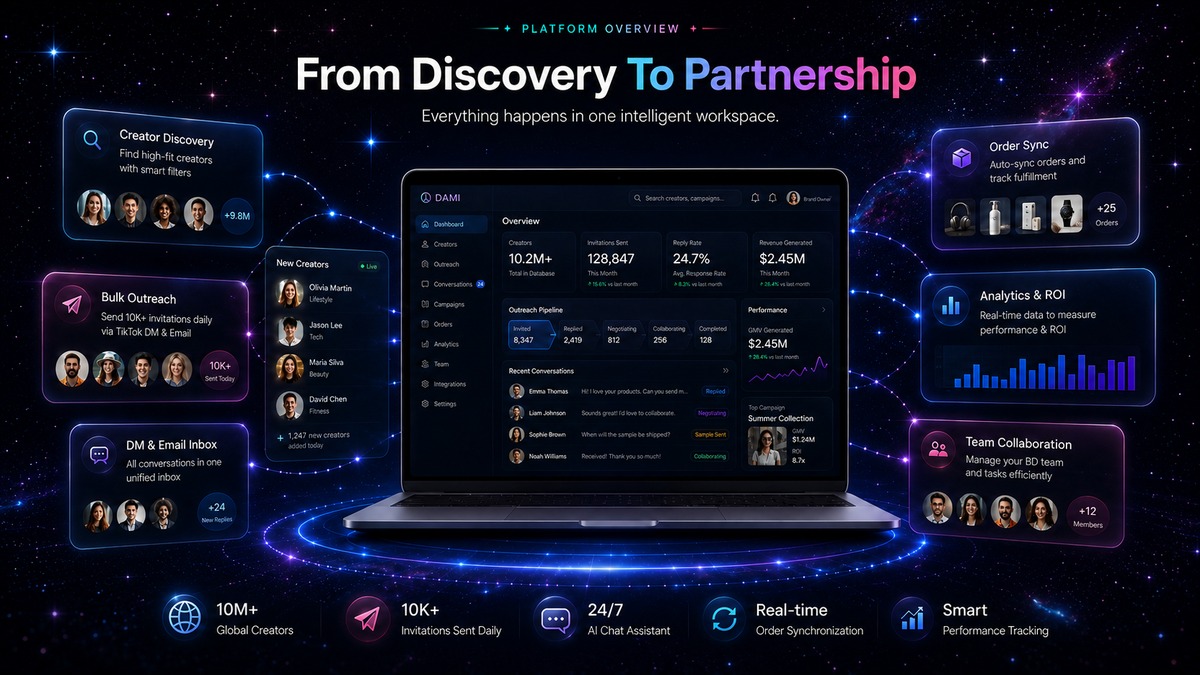
DAMI brings an 8-million-plus creator database, competitor and competitor-store creator search, automated outreach tasks, AI-assisted outreach, sample management, campaign management, store analytics, and multi-store team dashboards into one place. For a team of two to five people, the practical difference is that the list, the status and the numbers live in one place instead of being rebuilt every Monday from five different screens. Volume and precision both need plumbing. The 8-million-plus creator database and competitor creator search build the list, automated outreach tasks run the three-touch cadence without anyone keeping a spreadsheet in their head, AI-assisted outreach keeps the second and third messages specific instead of copy-paste, and email outreach with link tracking shows which message was actually opened before the reply came.
Start with DAMI and run this as a weekly routine instead of an emergency.
Frequently asked questions
How many outreach messages a day is reasonable?
Twenty to thirty from one account, spread across the day, is a working ceiling. Above that, reply rates fall and the account starts to look automated — and platform-side limits on new conversations are real, so a blocked account costs more than a slow week.
Is email better than DMs?
Neither wins alone. DMs get seen, email gets read. The pattern that works is DM first, email as the documented second touch with a one-page brief attached, then a single follow-up on the profile channel.
Should I offer product instead of a fee?
Only when the creator already sells in your category and the product is genuinely useful to their audience. A pure product trade reads as a discount request; if the budget is small, a smaller fee plus product converts better than product alone.
Does AI-written outreach sound fake?
It does when it invents details. Used correctly, AI should draft the structure while you supply two specifics — a video you actually watched and a number you can actually pay. The fakeness people notice is not the wording; it is the absence of anything only you could have known.
Conclusion
Reply rate is a design problem. Change what the first message contains, how many channels carry it, and what happens after a no, and the same thirty messages a week will produce three or four times the conversations. The creators were never ignoring you; they were answering the message you actually sent.
DAMI brings an 8-million-plus creator database, competitor and competitor-store creator search, automated outreach tasks, AI-assisted outreach, sample management, campaign management, store analytics, and multi-store team dashboards into one place. For a team of two to five people, the practical difference is that the list, the status and the numbers live in one place instead of being rebuilt every Monday from five different screens. Get started with DAMI and make the next round of decisions from records, not from memory.