
If you are an Indonesian TikTok Shop seller preparing to sell your products in overseas markets, one of the first challenges you may face is not finding a product.
It is figuring out where to find your first overseas Creators and who is actually worth working with.
Many sellers start by searching TikTok for keywords, opening accounts one by one, checking their profiles, copying usernames, sending messages, and recording everything manually.
This can work when you only need to find a few Creators.
But once you start looking for dozens or hundreds of Creators, you quickly realize something:
Finding Creators is not the hardest part. Finding the right Creators is.
For Indonesian sellers expanding into overseas markets, the difficulty becomes even greater. Once your target market changes from Indonesia to the US, the UK, other Southeast Asian countries, or Europe, language, content style, audience behavior, and purchasing habits all change.
That is why your first batch of overseas Creators should not be about finding the largest possible number of people.
It should be about building a repeatable Creator sourcing process.
TikTok Shop itself provides Affiliate collaboration features. Sellers can use Open Collaboration to allow eligible Creators to discover their products, or use Targeted Collaboration to invite specific Creators directly.
But if your goal is to actively build your own overseas Creator network, simply putting products into Open Collaboration is usually not enough.
The real questions are:
What kind of Creators should you look for? Where should you find them? How should you screen them? How should you approach them? And how should you manage them after the collaboration starts?
That is where the real work begins.
1. Your First Overseas Creators Should Not Be Selected by Follower Count
This is one of the most common mistakes sellers make.
Suppose you are an Indonesian seller preparing to sell a beauty product in the US.
You search TikTok for US Creators and quickly find accounts with 100K, 500K, or even millions of followers.
The numbers look impressive.
But if those Creators have little connection with your product or target customers, a large following may simply mean a larger waste of time and budget.
For your first batch of Creators, I recommend using a simple framework:
Market Fit × Content Fit × Product Fit × Commercial Willingness
Market fit tells you whether the Creator's audience is relevant to your target market.
Content fit tells you whether the Creator's usual content matches your product category.
Product fit tells you whether your product can naturally appear in their content.
Commercial willingness determines whether there is a realistic chance of moving from initial contact to an actual collaboration.
A US Beauty Creator with 200K followers may therefore be more valuable than a 2-million-follower entertainment Creator who has no natural connection to your product.
This is why follower count should not be your first screening criterion.
2. Define the Type of Creator You Want Before Searching
Before you start searching, define the Creator categories you actually need.
Suppose you are an Indonesian brand preparing to enter the US market.
Don't simply search:
"USA TikTok influencer"
That keyword is far too broad.
Instead, start from your product and identify the content categories that naturally fit it.
For home products, you might look at:
- Home Decor
- Home Organization
- Cleaning
- Kitchen
- Lifestyle
- Family
For beauty products:
- Beauty
- Makeup
- Skincare
- GRWM
- Beauty Tips
- Self Care
For fitness products:
- Fitness
- Workout
- Gym
- Running
- Healthy Lifestyle
The purpose is simple:
You are not looking for people who have followers.
You are looking for people who already own a content environment where your product makes sense.
This one step can significantly improve the efficiency of the entire Creator sourcing process.
3. Build a Small but Relevant First Creator List
Another common mistake is believing that more Creators are always better.
So a team may collect hundreds of accounts every day.
Then another problem appears:
Who are these people?
Who has been contacted?
Who replied?
Who received samples?
Who published content?
Who is worth working with again?
If all this information is scattered across spreadsheets, TikTok messages, WhatsApp, and different team members' conversations, the management cost increases rapidly as the Creator pool grows.
For your first batch, I recommend focusing on building a Creator Pool that can continue to grow.
For example, start with 100 Creators and divide them into three groups:
A — Priority Creators
Highly relevant content, suitable target audience, and consistent recent activity.
B — Test Creators
Good potential, but not enough data yet to make a strong judgment.
C — Resource Creators
Not a current priority, but potentially useful for future products or campaigns.
This gives you more than a list of influencers.
It gives you a working Creator resource pool.
4. Manual TikTok Search Becomes Inefficient as Your Creator Pool Grows
The biggest problem with manual search is not that you cannot find Creators.
It is the amount of repetitive work involved.
You may need to:
Search keywords;
Open accounts;
Check followers;
Review content;
Check market relevance;
Record usernames;
Find contact information;
Copy everything into a spreadsheet;
Then send messages one by one.
If you only need ten or twenty Creators, that is manageable.
But if your goal is to build a pool of 100, 500, or more Creators, this process quickly becomes a repetitive administrative task.
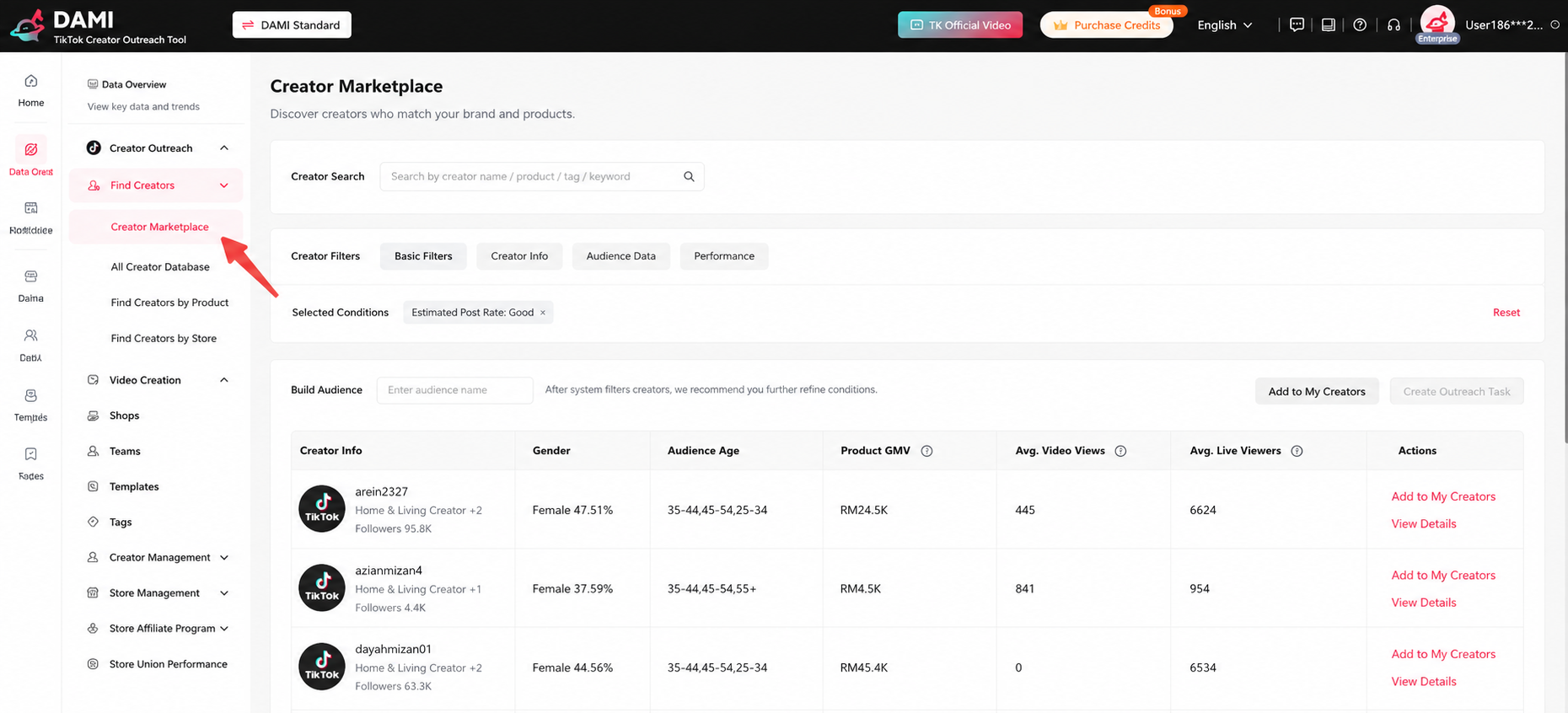
This is where a Creator search and outreach platform such as DAMI can become useful.
The value is not simply "finding Creators."
The bigger value is connecting the different steps of Creator operations.
For Indonesian sellers doing cross-border business, a more practical workflow is:
Define the target market → Search Creators by category → Screen relevant Creators → Build a Creator list → Start outreach → Manage follow-ups.
The tool should support the workflow instead of becoming just another database.
5. When Using DAMI to Find Overseas Creators, Set the Search Criteria First
Suppose you are an Indonesian brand preparing to sell in the US.
The first step should be clear:
Target Market: United States
Then select Creator categories based on your product.
For example, if you sell kitchen products, you can explore categories such as:
Kitchen
Cooking
Home
Food
Lifestyle
But don't immediately add every search result to your list.
You should look at:
Does this Creator consistently produce content in this category?
Is the audience relevant to your target market?
Does the Creator regularly demonstrate products or use products in real-life situations?
Do the comments show genuine product discussions or purchase intent?
Has the Creator been consistently active recently?
These factors are often more useful than follower count alone.
DAMI can help improve the efficiency of Creator search and screening, but the final decision should still come from the seller's understanding of the product and target market.
6. I Recommend Looking at These Five Metrics When Screening Creators
1. Content Relevance
This should come first.
Don't force a Creator to promote an unrelated product simply because they have a large following.
If your product naturally fits the Creator's usual content, communication and collaboration become much easier.
2. Recent Content Consistency
Don't focus only on the Creator's historical viral videos.
A Creator may have one video with 5 million views, but that does not mean their current videos perform at the same level.
Look at:
Are they posting consistently?
Are recent videos performing steadily?
Has their content direction changed?
You are collaborating with the current Creator, not their viral performance from six months ago.
3. Audience and Target Market
This is especially important for Indonesian sellers expanding overseas.
If you want to sell in the US, don't simply ask:
"Is this Creator American?"
A better question is:
Who does this Creator actually influence?
Market, language, content context, and audience characteristics should all be considered together.
4. Content-to-Commerce Fit
Some Creators have extremely high views, but their content is mainly entertainment, trends, or comedy.
They may not be ideal for Affiliate selling.
Meanwhile, a Creator with a smaller following who regularly creates product reviews, tutorials, unboxings, or product demonstrations may have stronger potential for product conversion.
So:
Good at creating content ≠ Good at selling products.
5. Long-Term Collaboration Potential
Your first batch of Creators should not all be treated as one-time partners.
If a Creator performs well in the first collaboration, you can test additional SKUs with them.
Over time, you are building a group of Creators that can continue working with your brand.
That is far more valuable than starting from zero every month.
7. Finding Creators Is Only Half the Job. The Real Challenge Is Outreach
Many sellers eventually discover something interesting:
Finding 100 Creators may not be that difficult. Getting some of them to respond is the real challenge.
Especially when working with overseas Creators.
If your first message simply says:
Hi, we want you to promote our product.
It is easy to ignore.
A better approach is to make three things clear:
Who you are.
Why you chose this Creator.
What kind of collaboration you are proposing.
For example:
Hi [Name],
We’ve been following your home organization content and really like the way you demonstrate practical products.We’re currently looking for creators in the US market to collaborate on [product category].
We’d love to explore a commission-based collaboration with you.
The message doesn't need to be complicated.
The important thing is to make the Creator feel that:
You actually looked at their content instead of sending a random mass message.
8. This Is Where DAMI Becomes More Than a Creator Search Tool
If you only have ten Creators, manual outreach is completely manageable.
But when you have already screened 100, 300, or more Creators, efficiency becomes important.
DAMI's Creator outreach capabilities can help connect the process after you have searched and screened your target Creators.
For example, you can build different Creator groups based on content categories:
US Beauty Creators
US Home Creators
US Fitness Creators
US Lifestyle Creators
Then prepare different collaboration messages for different Creator types.
This is more reasonable than sending exactly the same message to everyone.
Because:
Different Creators have different content environments, so your communication should also be adapted accordingly.
The value of DAMI at scale is reducing repetitive Creator operations rather than deciding which Creator will definitely generate sales.
\
- Don't Contact Everyone at Once
This is another point Indonesian sellers should pay attention to.
If you find 300 Creators in the first round, that does not mean you should contact all 300 at once.
A better approach is to run a small test batch.
For example:
Round 1: 50 Creators
Then observe:
Reply rate;
Collaboration acceptance rate;
Sample requests;
Content publishing rate;
Initial sales performance.
Then use the first-round data to adjust your screening criteria.
If Beauty Creators have a significantly higher response rate than Lifestyle Creators, increase the proportion of Beauty Creators in the next round.
If a particular content type generates better sales results, expand that Creator category.
At this point, Creator outreach changes from:
"Find people → Send messages"
into:
"Find → Test → Analyze → Optimize → Find again."
That is where scalable Creator operations become valuable.
10. Group Your Creators to Make Management Easier
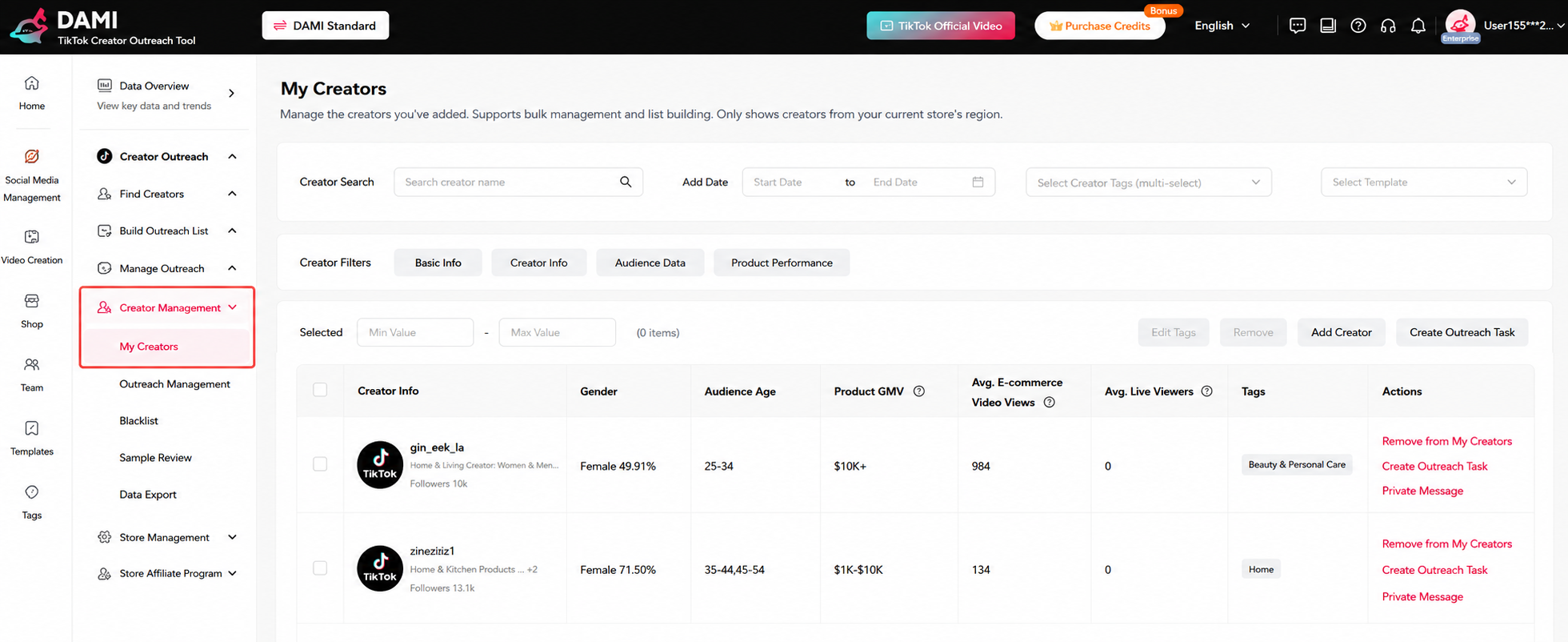
As the number of Creators increases, don't put everyone into one list.
You can organize them according to their collaboration stage:
To Contact
Newly selected Creators who have not yet been contacted.
Contacted
Collaboration invitation has been sent and you are waiting for a response.
Replied
The Creator has responded and further communication is needed.
Collaborating
The partnership has been confirmed.
Sample Sent
The product sample has entered the collaboration process.
Published
The Creator has published content.
Priority Creators
Creators who have already demonstrated good potential and are worth long-term cooperation.
At this point, DAMI's value can extend from Creator discovery to Creator resource and collaboration management.
For cross-border sellers, this becomes increasingly important.
When your Creator pool grows from 20 to 200, you are no longer dealing with a simple "influencer search" problem.
You are dealing with a real Creator Operations problem.
11. Don't Expect Your First Batch of Creators to Produce an Instant Viral Hit
This is one of the easiest things to overlook.
Many sellers start their first Creator campaign with one expectation:
"I need to find a few Creators and immediately generate sales."
That expectation can lead to the wrong decisions.
The first batch of Creators is more valuable for answering questions such as:
Which type of Creator fits my product?
Which content formats work better in the target market?
Which Creator types are more willing to collaborate?
Which outreach messages get better responses?
Which Creators are worth maintaining long term?
Once these answers become clearer, you will know who to look for in the next round.
So the core purpose of your first Creator campaign is not necessarily to maximize sales immediately.
It is to:
Build your first overseas Creator screening model.
12. Indonesian Sellers Should Build Creator Assets, Not Just Creator Lists
If you start from scratch every time you enter a new market, searching TikTok, creating another spreadsheet, and sending another round of messages, every new campaign becomes a new beginning.
But if you continuously record the Creators you have already worked with:
What type of content they create;
Which products they are suitable for;
Which SKUs they have promoted;
How quickly they respond;
How their content performs;
Whether they are worth re-engaging;
You gradually build your own Creator Pool.
When you launch a new product, you don't have to start by finding 100 strangers.
You can first look at the Creators you have already tested.
That is the long-term value of Creator operations in cross-border e-commerce.
Conclusion: Your First Overseas Creators Build More Than Your First Sales
For Indonesian sellers, TikTok cross-border selling is not simply about putting your products in front of customers in another country.
Once you enter a new market, you are entering a completely different content ecosystem.
Your first overseas Creators therefore have a role beyond generating your first orders.
They help you discover:
What kind of people fit your products, what kind of content works in the target market, and what kind of collaboration model can continue to operate.
If you only need a few Creators occasionally, manual search and outreach may be enough.
But when you start operating multiple products and markets and need to continuously build Creator resources, relying entirely on spreadsheets, chat apps, and manual searches can create a large amount of repetitive work.
This is where DAMI can fit into the workflow:
From Creator discovery and screening to bulk outreach and collaboration management, DAMI helps turn fragmented Creator operations into a more repeatable workflow.
For Indonesian sellers who are just starting TikTok cross-border selling, I would not recommend trying to find "as many Creators as possible" from day one.
Start by finding the right first batch and getting the process right.
Once you know who to look for, why to choose them, how to approach them, and how to review the results, increasing the number of Creators becomes much more meaningful.
DAMI CTA
If you are looking for TikTok Creators in the US, Southeast Asia, Europe, and other markets, DAMI can help you build your own Creator resource pool, from Creator discovery and screening to bulk outreach and collaboration management.
👉 Learn more about DAMI / Start finding overseas Creators:https://portal.dami.co.id/id/login?type=1&urlCode=1785815973408